
How to Choose a Motorized Platform Cart by Load Capacity
- Author
- By Raphael Perlmann
- Reading time
- 3 min read
Summary
Weigh the heaviest single load, then pick the lightest platform cart rated above it. Deck size, deck height and the ramps on the route decide the rest.
On this page
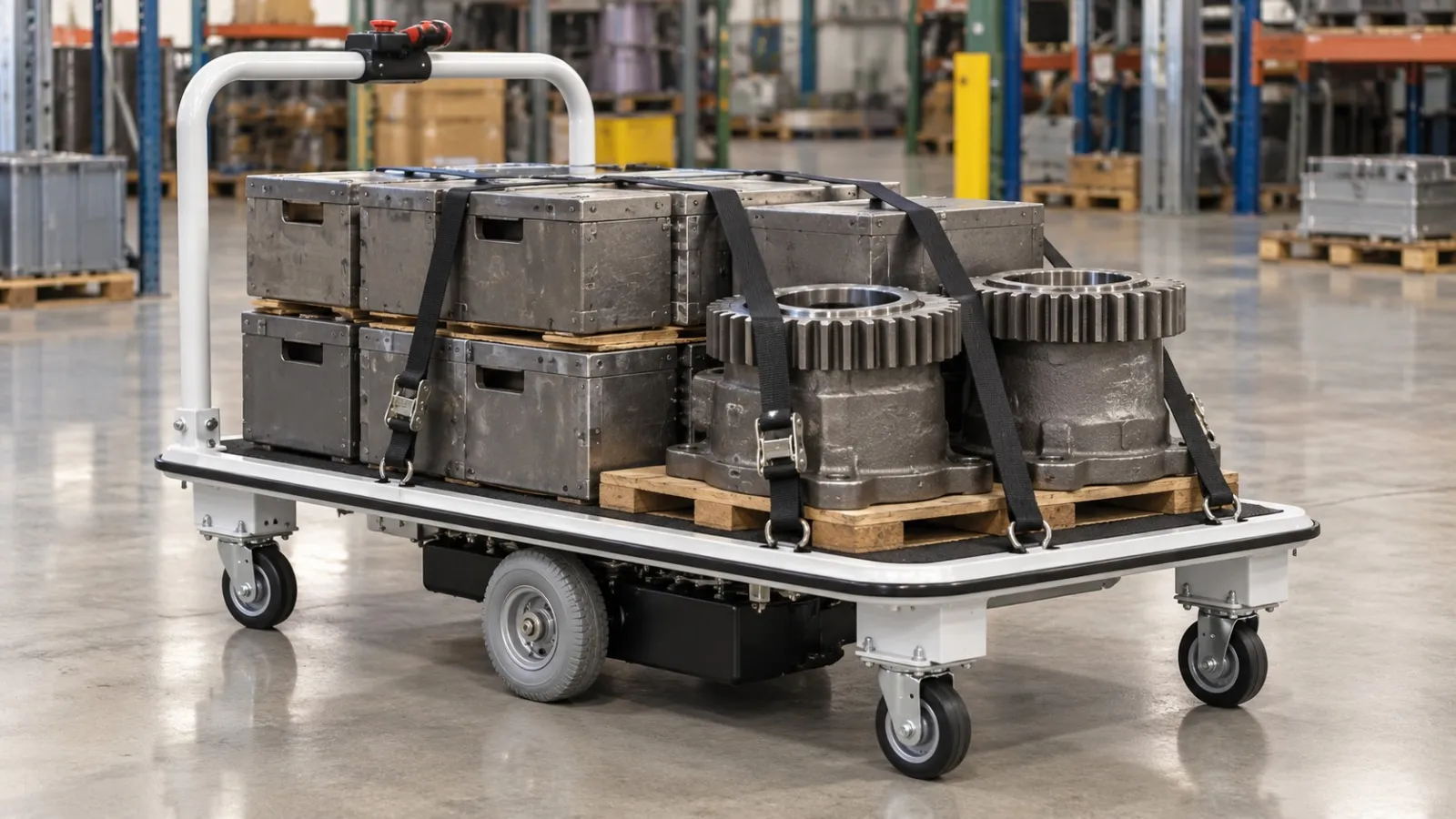
Choose a motorized platform cart by the heaviest single load it will carry. Weigh that load, then pick the lightest cart whose rating clears it with room to spare. Deck size, deck height and the ramps on the route decide the rest.
Start with the heaviest load
Put the heaviest pallet, cage or fixture on a scale and use the real number. The rating on a platform cart is the weight its deck carries while the cart drives itself across a level floor.
Rate the cart above the load, not at it. If the load is 1,800 lb, a 2,000 lb cart leaves little margin for a second item set on top or an uneven deck. A cart that runs at its limit every shift wears its brakes and drive sooner.
Match the load to a model
- Up to 1,000 lb on a level floor is the Pony Express 1040.
- Up to 1,000 lb with a ramp on the route is the 1040-E series, rated for 15 degrees at full load (12 degrees on the long 1040-LE).
- 1,500 or 2,000 lb is the 1031 series.
- 3,000 or 4,000 lb is the 1032 series.
- Heavier single loads go to a custom cart, built up to 30,000 lb.
There is no 2,500 lb platform model in the standard line. A load between 2,000 and 3,000 lb steps up to the 1032-3000.
Size the deck to the load
The load should sit fully on the deck, inside the bumper. Measure its longest and widest points and pick a deck that holds both.
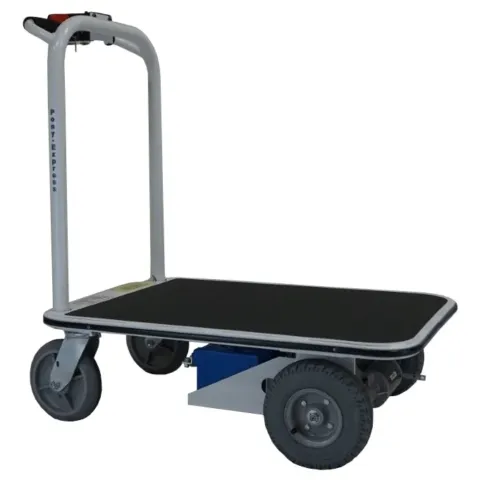
The 1040 and 1040-E have a 24 by 32 inch deck. The 1040-E series also comes 25.5 inches wide in 40, 49 and 61 inch lengths, and 34.5 by 52 inches. The 1031 series comes 25.5 inches wide in 40, 49 and 61 inch lengths, or 34.5 by 52 inches. The 1032 uses the 34.5 by 52 inch deck.
Pick the shortest deck that holds the load. A shorter cart turns and parks in less space and fits a smaller elevator.
Check deck height and ramps
The 1031 and 1032 decks sit 11.5 inches off the floor. The 1040 and 1040-E sit at 12 inches, and the longer 1040-E decks at 15 inches. A lower deck is easier to load by hand.
Ramps matter as much as weight. The owner manual limits the 1031 and 1032 to 6 degree inclines, and the 1040 is rated for 3 degrees at full load. If the route crosses a dock ramp, the 1040-E series carries 1,000 lb up a 15 degree incline. Every model stops and holds when the operator lets go.
Cart or tugger
A platform cart carries one load on its own deck. An electric tugger tows a train of wheeled carts, 1,000 to 50,000 lb on a flat floor. The platform cart owner manual says not to use the cart to push or pull other carts, so if the job is pulling several carts at once, choose a tugger.
Battery and shift
The 1031, 1032, 1040 and 1040-E run about 8 hours per charge on 35 or 44 Ah AGM batteries. The charger is built in and plugs into a 120 or 240 volt outlet, and a full recharge takes about 4 hours.
What to send for a quote
- The weight and footprint of the heaviest load
- The steepest ramp on the route and the floor surface
- Door widths and the elevator car size, if the route has one
- Your delivery ZIP code
We check the load and the route and send a written quote with the cart, freight and build time.
Related collections
-
Motorized Carts
-

More guides
-
Gas Cylinder Carts
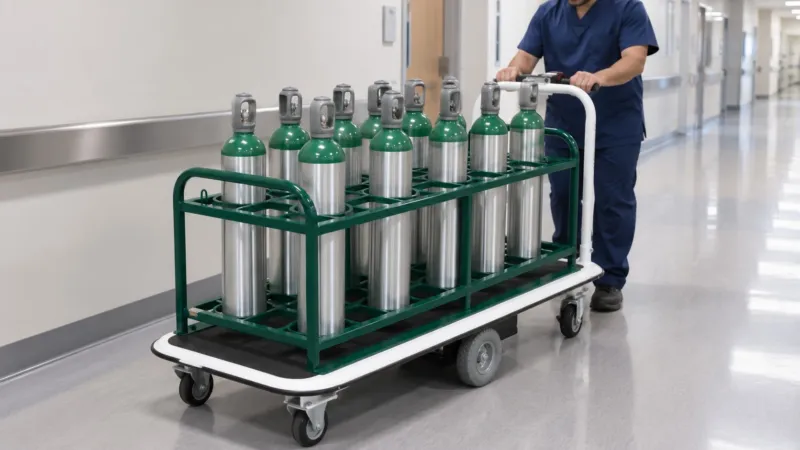
How to Transport Oxygen Cylinders Safely in a Hospital
Secure each cylinder upright, cap the valve, keep oxygen away from fuel gases and move at walking speed. The rules, the steps and when a powered cylinder cart makes sense.
-
Compact Tuggers
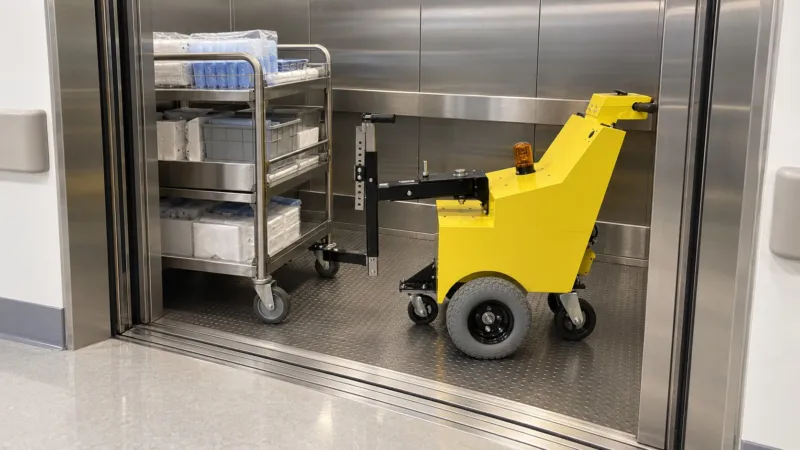
How to Choose an Electric Tugger for Narrow Aisles and Tight Spaces
Measure your tightest aisle, door and elevator first, then pick the smallest tugger body that clears them and still tows your heaviest cart.
-
Lithium Tuggers
How to Pick a Tugger Battery for Runtime, Charging and Multi-Shift Use
Pick a tugger battery by your shift pattern. AGM fits one shift with an overnight charge, and a swappable lithium pack keeps a tugger working across back to back shifts.